
Last Updated on October 8, 2026 by Wayne Rodick
We’ve been elbow-deep in hydraulic systems around Houston for years now at Coastal Hydraulics, and there’s one repair that keeps landing on our bench: the burst hose. Here’s the thing that gets us every time – most of those bursts were avoidable.
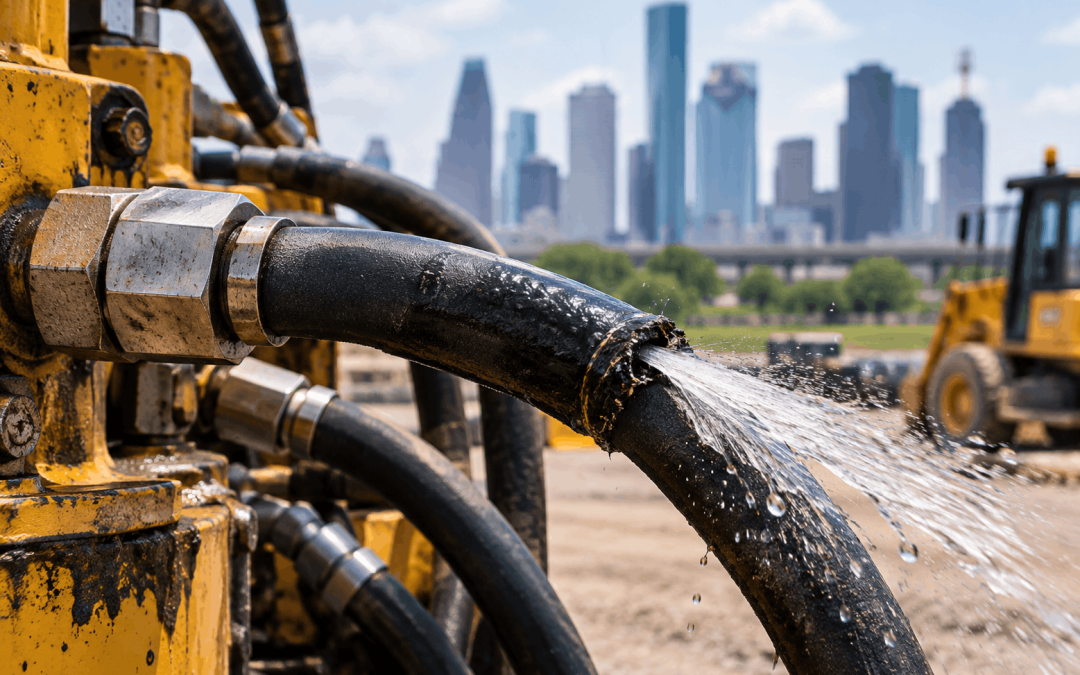
A hose doesn’t fail quietly, either. One lets go, and suddenly you’re staring at halted operations, maybe an injury, banged-up equipment nearby, and a downtime bill that hurts a lot more than the part ever would. But bursts follow patterns. Learn the patterns, factor in what our climate does to your gear, and you can usually spot trouble coming from a mile off.
So let’s get into it: what actually causes these bursts, how Houston makes everything worse, and the warning signs we point out to every client who’ll listen.
The Most Common Causes of Hydraulic Hose Failure
Every job’s a little different, but bursts keep circling back to the same handful of causes. Get to know them, and you’ll build habits that keep your equipment working instead of sitting in our shop.
Pressure That Exceeds the Hose’s Design Limits
Every hose has a rated working pressure and a max surge pressure. Blow past those numbers – a relief valve quits, a filter plugs up, somebody spec’d the wrong hose to begin with – and all that extra pressure keeps pounding the hose wall until it finally gives out. A hydraulic hose burst like this tends to come out of nowhere, with little to no warning. That’s the whole reason we harp on matching your hose specs to your actual system.
Material Degradation Over Time
Rubber, thermoplastic, composite – whatever your hose is made of, it’s on a clock. Sun, ozone, plain old wear and tear all whittle away at it. The material stiffens up, loses its give, and then it starts cracking under pressure it used to shrug off. Do yourself a favor here: swap hoses on the manufacturer’s schedule. Don’t wait for one to blow to prove a point.
Abrasion From Friction and Contact with Equipment
A hose that’s rubbing on a frame, a moving part, or its own neighbor grinds through its outer cover a little more every hour. Once that cover’s worn through, the reinforcement layer underneath is exposed – and that stuff weakens quickly. Mobile equipment is where we see it most, almost always because a hose wasn’t routed right or clamped down like it should’ve been.
Incompatibility Between Fluid and Hose Material
Fluids and hoses aren’t a mix-and-match situation. Put the wrong fluid through the wrong hose and the inner tube can swell, blister, or rot away somewhere you’d never think to check. By the time you need to fix burst hydraulic hose damage from fluid incompatibility, it’s already cost you far more than a simple swap would have. We catch this one a lot during inspections. Usually it’s a machine that’s changed owners, or somebody topped it off with whatever was on the shelf.
Manufacturing Defects and Improper Installation
This is the rarer one, but it’s real. A bad crimp or a flaw from the factory leaves a weak spot in a hose that otherwise looks fine. Then there’s installation, which trips people up just as often. Wrong routing, too tight a bend, a fitting torqued wrong either way – each one bakes in a stress point that’ll fail early. Honestly, that’s reason enough to let a seasoned tech handle the install.
How Houston’s Climate Contributes to Hydraulic Hose Bursts
Houston is rough on hydraulic gear, and we bake that into pretty much every recommendation we make.
Heat and Humidity Accelerate Rubber Breakdown
Our heat and humidity together age rubber hoses faster than they’ve got any right to. Hot temps soften the compounds over time, and softened rubber cracks – or fails under pressure – far sooner.
Salt Air Exposure Near the Coast
Work out near Galveston Bay or anywhere along the water, and you’ve got salt air to worry about too. It goes after the metal fittings and crimped connections, which happen to be the most vulnerable parts of the whole assembly.
Thermal Cycling From Temperature Swings
Temperatures around here bounce around hard – one season to the next, and sometimes just from morning to afternoon. All that expanding and contracting is what we call thermal cycling, and it slowly wears down hoses and fittings whether you notice or not.
Heavy Industrial Use and Continuous Operation
Plenty of our clients in manufacturing, construction, and oil and gas run their machines for long, punishing hours. That kind of nonstop workload stacks up the wear and barely gives hydraulic parts the breathing room a lighter-duty system enjoys.
Warning Signs That a Hydraulic Hose Is About to Fail
Catching trouble early beats mopping up after a burst, every single time. Build inspection into your routine and keep an eye out for these.
Cracks, Bulges, or Leaking Fluid
Cracks, bulges, fluid weeping out – they’re all telling you the same thing. This hose is done. Replace it now.
Unusual Noises or Vibrations
Machine suddenly running louder or shaking funny? Don’t wave it off. That shift can mean hose or system damage hiding on the inside, so go look.
Reduced System Pressure or Performance
When pressure drops, or the equipment feels sluggish, the trail often leads back to a hose – a collapsing inner tube, or a slow leak you haven’t found yet.
Discoloration or Brittleness
A hose gone faded, stiff, or brittle has lost most of its flex. That’s a hose running on borrowed time under everyday pressure.
Protecting Your Equipment Starts with Proactive Maintenance
Bursts almost never come out of nowhere. They come from wear you could’ve predicted, stress from the environment, or maintenance that quietly slipped by – and every bit of that is something you can stay ahead of with steady checks and timely swaps. Spotted a few of these signs? Or can’t recall the last time anybody actually looked your hoses over? If you’ve been searching for hydraulic hose repair near me in Houston, give us a call at Coastal Hydraulics. We diagnose and repair hydraulic systems all over Houston, and we’d be glad to keep yours running safely!
Wayne Rodick is the owner and founder of Coastal Hydraulics, a company built on the principle of “Speed to Recovery.” A U.S. Navy veteran, Wayne developed extensive hydraulic expertise while maintaining F-18 fighter jets, where precision, reliability, and rapid service were critical. Today, he brings that same commitment to excellence to the hydraulic repair industry, leading a team dedicated to delivering fast, dependable repairs that minimize downtime and keep equipment operating at peak performance.