
Last Updated on October 1, 2026 by Wayne Rodick
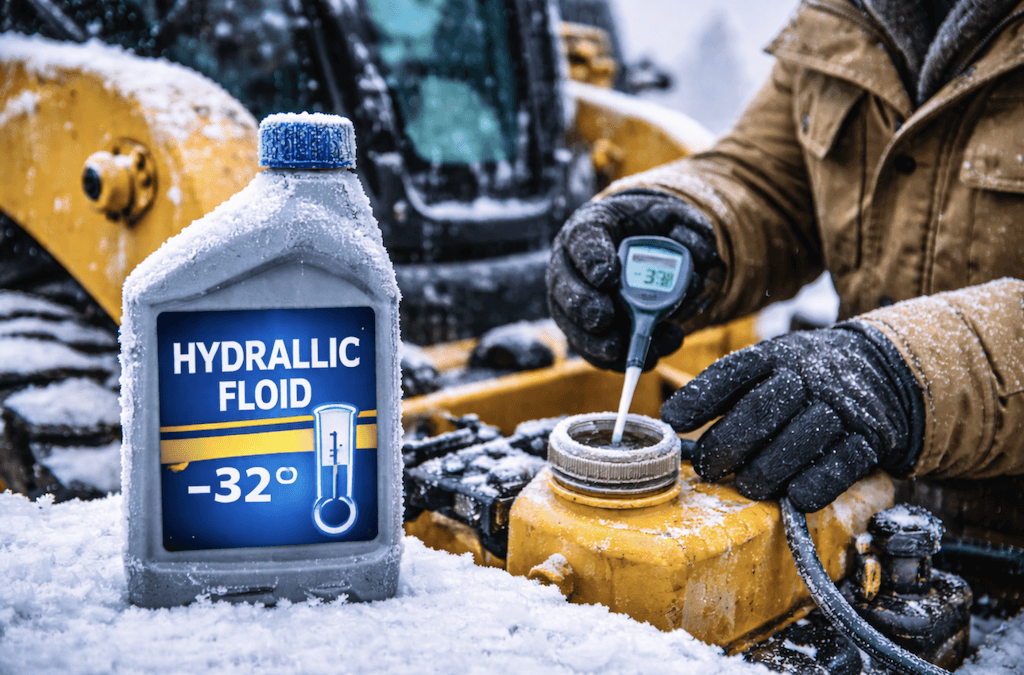
Winter months are always tough on any piece of equipment. When the cold weather settles in, many operators worry about the condition of the fluids keeping the equipment operational. Many people have asked us whether hydraulic fluid can freeze entirely and make it useless. Getting familiar with the impact of low temperature on the equipment is crucial for avoiding major problems.
If you’re facing issues with your system during the colder months, you might also consider professional hydraulic cylinder rebuild services to keep everything running smoothly. In this post, we will tell you how the cold weather impacts the hydraulics of your equipment and how to avoid issues.
Understand Freezing Points and Viscosity of Hydraulic Fluid
At the freezing point of thirty-two degrees Fahrenheit, water transforms into a solid cube of ice. Does hydraulic fluid freeze in the same way? Hydraulic fluid does not behave similarly. While the fluid won’t transform into ice, low temperatures will significantly affect its viscosity. In simple terms, viscosity means the oil’s resistance to flow and how thick it is. The thicker the oil gets as the temperature drops below zero, the harder it will be to move through the system.
At some point, the viscosity of hydraulic fluid reaches its pouring point. In other words, the oil gets so thick and sticky that it cannot move. Even though it will not freeze into a solid block of ice, this will create the exact same problems in the system. It will be difficult to run the machine since the oil’s thickness is going to stop it.
Can hydraulic fluid freeze? It’s important to know that while it doesn’t turn solid like water, extreme viscosity at low temperatures can make it behave as if it has.
What Makes Hydraulic Fluid Freeze?
Several factors play a big role in determining when exactly the fluid’s pouring point is reached. Firstly, you should consider the type of oil used by the manufacturer. Generally speaking, synthetic oils can survive much colder temperatures without thickening compared to mineral-based options. The hydraulic oil freezing point varies depending on formulation, and synthetic oil is formulated with molecules having similar structure, which prevents them from congealing.
Certain additives might be added to increase cold tolerance even more. These are called pour point depressants. These compounds keep wax crystals from forming as they try to stick together and become too thick. The existence of moisture is another factor influencing how fluid behaves in cold weather. Should you notice water accumulating in your tank, it will freeze separately from the freezing point of hydraulic fluid.
Hazards of Cold Hydraulic Oil
Operating with thickened hydraulic oil creates a lot of hazards. First, it creates problems with suction in the pump since the fluid will be unable to move as easily as it should. This phenomenon is known as cavitation and causes small vapor bubbles to form inside the hydraulic pump. The bursting of these bubbles will lead to severe wear in the pump. If you’re asking, at what temperature does hydraulic fluid freeze? It’s essential to remember that while hydraulic fluid rarely turns solid, severe cold still poses major operational challenges.
Cavitation isn’t the only problem that will emerge. Since the fluid will not flow, you will experience sluggish operation of cylinders and lack of force in other parts of the equipment. Another potential issue related to pumping thick fluid through narrow lines will be the development of high pressure that leads to ruptured lines and broken seals.
How to Protect Your Equipment
Keeping your hydraulic equipment operational is not easy but definitely possible. Firstly, you will have to use the correct fluid grade for winter weather. Ensuring that your equipment has enough time to warm up before being put under pressure will give the oil enough time to flow freely. If you feel like you could use a hand making sure your equipment is prepared for the cold, contact our maintenance specialists at Coastal Hydraulics!

Wayne Rodick is the owner and founder of Coastal Hydraulics, a company built on the principle of “Speed to Recovery.” A U.S. Navy veteran, Wayne developed extensive hydraulic expertise while maintaining F-18 fighter jets, where precision, reliability, and rapid service were critical. Today, he brings that same commitment to excellence to the hydraulic repair industry, leading a team dedicated to delivering fast, dependable repairs that minimize downtime and keep equipment operating at peak performance.