

Last Updated on July 23, 2026 by Wayne Rodick
Hydraulic cylinders are the engines of many industrial machines that convert fluid pressure into mechanical force. Whether it is construction or industry, hydraulic cylinders play an important role in lifting, pushing, or pulling heavy loads. As part of our hydraulic services at Coastal Hydraulics, we are aware that any fault in any part of the hydraulic cylinder can cause business to come to a grinding halt.
It is very important to have an understanding of each of the component functions in order to diagnose and troubleshoot problems and ensure reliability. When you’re familiar with the parts of a hydraulic cylinder, you can better identify what each piece does and why it is essential for efficient operation. In this guide, we will go over what each of the important pieces of a hydraulic cylinder consists of and what role each of them takes in the function of the hydraulic cylinder.
The Cylinder Barrel
The barrel of the hydraulic cylinder is essentially the main component of this device and contains the piston and fluid. As one of the critical hydraulic cylinder parts, it is commonly made of seamless honed steel tubing, required to be durable and resist pressures, in addition to possessing the quality of having a smooth surface on which the piston glides. In fact, the barrel of the hydraulic cylinder holds very important positions and should be unblemished, as any damage to it may cause leakage of fluid.
The Piston and Piston Rod
The piston is a cylindrical device that oscillates back and forth in the barrel due to fluid pressure. As one of the essential hydraulic cylinder components, it is connected to the piston or control shaft, which is chrome-plated and protrudes from the cylinder to transfer the resulting force to the machine work load. It is the movement of the piston that leads to mechanical action. There must be strong linkage between the piston and the control shaft in order to resist the vast forces that are involved in hydraulic systems.
Seals and O-Rings
Seals are maybe the most important factors for leak prevention and pressure retention. As critical components of a hydraulic cylinder, piston seals are situated on the top of the piston and act as fluid barriers that prevent fluid from passing around the piston and allow proper pressure on one side.
Rod seals are situated in the cylinder head and work as fluid barriers that prevent fluid leakage out of the cylinder and along the piston rod. O-rings and other types of seals are situated in the cylinder and work as fluid barriers in stationary areas of the cylinder. Faulty seals are the leading cause of hydraulic cylinder breakdowns.
Cylinder Head and End Cap
The cylinder head, or gland, seals the end of the cylinder barrel and helps to guide the piston rod as it moves in and out. Inside it houses the seals for the rod and the wiper seal that removes any debris left on the end of the rod as it retraction mechanism goes back inside the cylinder. Towards the other end, the end cap or cylinder base houses the barrel of the cylinder.
Ports and Fittings
Hydraulic fluid enters and leaves the barrel of the cylinder through ports. These are threaded holes that are used to connect hydraulic hoses and fittings. Port location and size depend on fluid control of piston movement, whether single acting or double acting in nature. It is vital that fittings are securely tightened and of the right size to allow hydraulic fluid to flow at all times.
Keeping Your Cylinders in Top Condition
Every component of the hydraulic cylinder serves its individual and vital role. By operating together in harmony, you can enjoy the power and accuracy of your machine. If you have observed some leakage, decrease in performance, or an unusual sound coming from it, it may be an indication that one of its components needs some attention. Preventive maintenance and repair are the keys to maximizing the life of your hydraulic systems. Our team at Coastal Hydraulics is always at your service when you need professional repair for hydraulic cylinders.
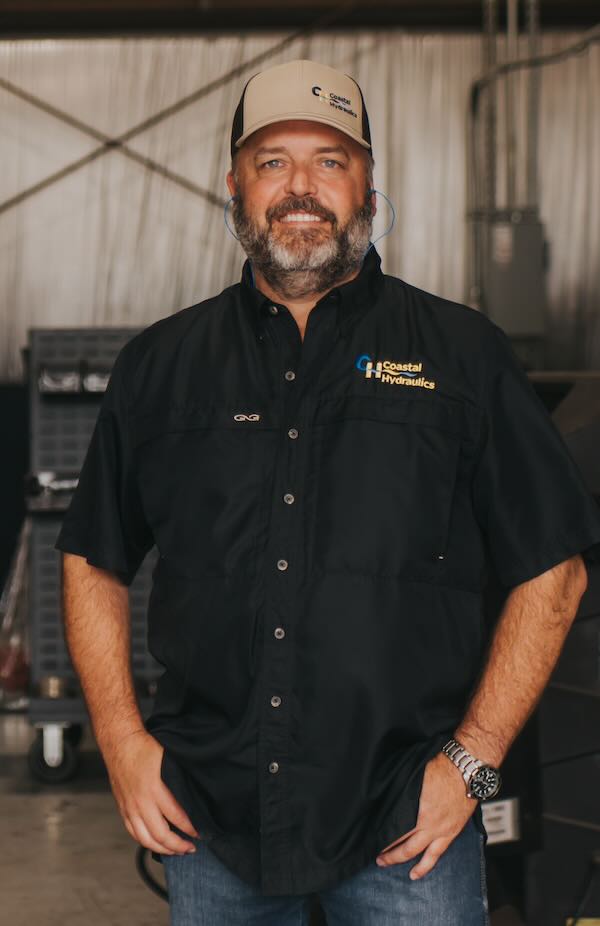
Wayne Rodick is the owner and founder of Coastal Hydraulics, a company built on the principle of “Speed to Recovery.” A U.S. Navy veteran, Wayne developed extensive hydraulic expertise while maintaining F-18 fighter jets, where precision, reliability, and rapid service were critical. Today, he brings that same commitment to excellence to the hydraulic repair industry, leading a team dedicated to delivering fast, dependable repairs that minimize downtime and keep equipment operating at peak performance.